IREIT FY26: Earnings Surge 177%, but Property Revaluation Drives the Bottom Line
Image REIT posts robust growth in revenue, operating profit and earnings per unit; investors should focus on recurring income, NAV and cash distributions
By Pakistan Bakhabar News Desk6 min read
Image REIT (IREIT) delivered a strong financial performance in FY2026, with revenue and operating profitability recording healthy year-on-year growth while profit after tax surged by 177%. However, a deeper examination of the results shows that the sharp increase in bottom-line earnings was significantly supported by gains arising from the revaluation of investment properties.
According to the latest results filed with the Pakistan Stock Exchange (PSX), IREIT's revenue increased to Rs114.15 million in FY2026 from Rs85.93 million in FY2025, representing growth of approximately 33%.
The improvement at the operating level was even stronger. Net operating profit rose by 56.3% to Rs98.44 million, compared with Rs62.99 million a year earlier.
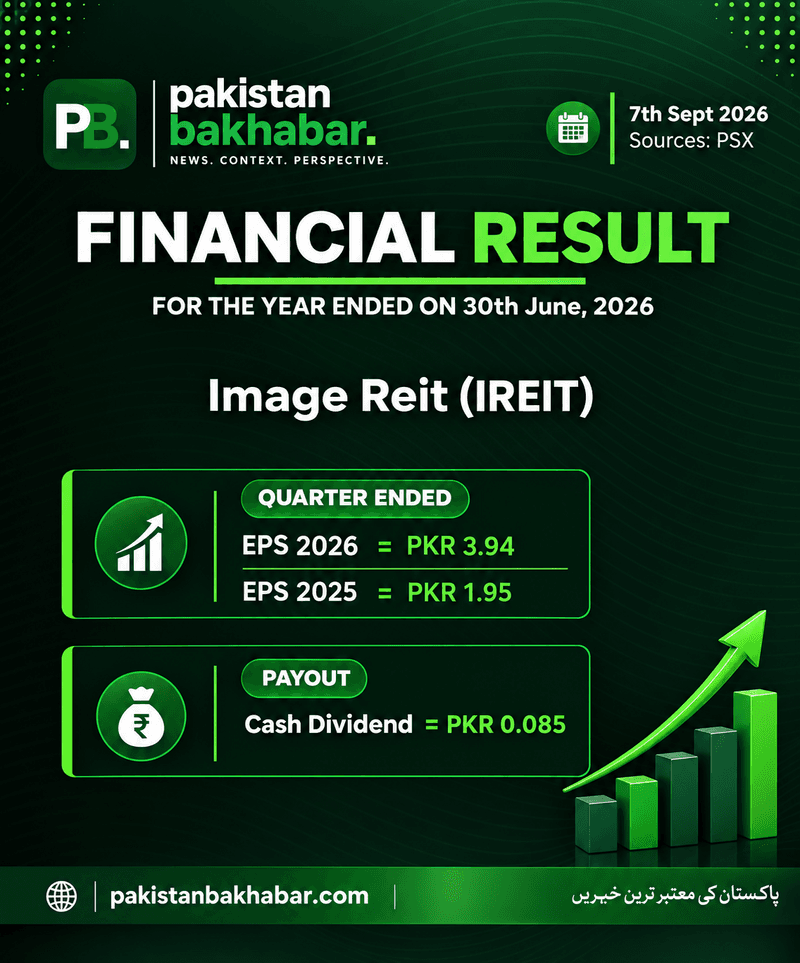
The company's profit after tax jumped to Rs991.54 million from Rs357.93 million, while earnings per unit more than doubled to Rs3.94 from Rs1.95.
On the surface, the numbers point to an exceptional year for IREIT. However, investors need to distinguish between recurring operating income and gains generated through property valuation.
Core business shows encouraging momentum
The strongest aspect of the FY2026 result is the improvement in IREIT's underlying operations.
Revenue has increased consistently over the past three financial years, rising from approximately Rs41.5 million in FY2024 to Rs85.9 million in FY2025 and Rs114.2 million in FY2026.
This represents growth of nearly 175% over two years and indicates that the REIT's income-generating base is expanding.
Net operating profit has also strengthened substantially. The 56% increase in FY2026 was significantly higher than revenue growth, indicating an improvement in operating profitability.
The operating margin increased from approximately 73% in FY2025 to around 86% in FY2026, highlighting stronger operating efficiency.
For investors, this is arguably more important than the headline PAT growth because recurring operating income provides the foundation for sustainable distributions.
Revaluation gains remain the major caveat
While the earnings growth is impressive, the composition of the profit requires closer attention.
IREIT, like other property-focused investment vehicles, recognises investment properties at fair value. When the valuation of these properties increases, the resulting gain can be recognised in the income statement.
Such gains can materially increase reported earnings and net asset value, but they are generally unrealised and non-cash in nature.
IREIT also recorded a substantial fair-value gain on investment properties in FY2025. The sharp acceleration in profit during FY2026 indicates that property revaluation again made a significant contribution to the bottom line.
This means the 177% increase in PAT should not be interpreted as a 177% increase in recurring cash earnings.
For valuation purposes, investors should therefore separate the company's operating earnings from property valuation gains.
Q4 provides an important signal
The fourth-quarter numbers further highlight the difference between operating growth and reported profitability.
Based on the annual and nine-month results, IREIT generated approximately Rs29.5 million in revenue during Q4 FY2026, compared with around Rs26.8 million in Q4 FY2025 — an increase of roughly 10%.
Profit, however, increased to approximately Rs640 million from Rs146 million.
The dramatic divergence between revenue and profit growth indicates that the fourth quarter benefited heavily from non-operating items, particularly property valuation gains.
Consequently, investors should be cautious about using the Q4 earnings run-rate to forecast FY2027 profitability.
EPS growth remains impressive despite dilution
One of the more encouraging aspects of the result is the performance of earnings per unit.
IREIT's unit base expanded substantially following its IPO in 2025. Despite the larger number of outstanding units, earnings per unit increased from Rs1.95 to Rs3.94.
This suggests that the company's earnings growth was strong enough to offset the impact of the enlarged unit base.
IREIT's IPO raised approximately Rs920 million, providing additional capital for the company's property and development activities. The effective deployment of these funds and their eventual contribution to recurring income will be important catalysts for future earnings.
Dividend provides additional support
Distribution remains a key part of the IREIT investment case.
The company announced a final cash dividend of Rs0.085 per unit for FY2026, taking total FY2026 distributions to approximately Rs0.415 per unit.
IREIT has also announced an early interim cash dividend of Rs0.145 per unit for FY2027.
At the September 7 closing price of Rs8.36, the FY2026 distribution translates into a historical cash yield of approximately 5%.
While this is not an exceptionally high yield compared with some income-oriented stocks on the PSX, the combination of distributions and potential NAV appreciation could make IREIT attractive to investors seeking exposure to real estate.
Valuation looks inexpensive — with a major qualification
At Rs8.36 per unit, IREIT trades at a headline trailing P/E of roughly 3.6x.
On a conventional equity basis, that would appear extremely inexpensive. However, applying a P/E multiple to a REIT can be misleading when earnings contain large fair-value gains.
A better approach is to examine:
• NAV per unit
• Price-to-NAV
• Property valuations
• Recurring rental income
• Cash available for distribution
• Distribution yield
• Debt and leverage
• Development pipeline
The most important valuation question is therefore not simply whether IREIT is trading at a low P/E, but how much of its underlying asset value is being reflected in the current market price.
Market reaction was positive
The market appeared to respond positively to the results.
IREIT closed Monday at Rs8.36, up 4.5%, even as the broader KSE-100 Index declined by approximately 0.97%.
The stock, however, remains well below its 52-week high of Rs13.05 and below its Rs10 face value.
This suggests that despite the sharp improvement in earnings, the market continues to assign a degree of caution to the company's future earnings profile.
What investors should watch in FY2027
The next phase of IREIT's story will depend less on another large property revaluation and more on the company's ability to grow recurring operating income.
Three indicators will be particularly important.
First, rental and operating income. Continued growth would demonstrate that the company's underlying assets are generating stronger cash flows.
Second, cash distributions. Sustainable or rising distributions would provide evidence that the earnings improvement is translating into shareholder returns.
Third, NAV growth and development execution. Successful development and appreciation of the company's property portfolio could create additional value, but investors should monitor whether such gains are being converted into cash-generating assets.
Investment view
IREIT's FY2026 results are fundamentally encouraging, but they should not be viewed solely through the lens of the 177% increase in profit.
The underlying business has clearly improved, with revenue rising 33% and operating profit increasing 56%. Earnings per unit also more than doubled despite the enlarged unit base following the IPO.
The key caveat is that a substantial portion of the exceptional bottom-line performance appears to be linked to property revaluation gains. These gains can strengthen NAV but do not carry the same recurring quality as rental income or operating cash flow.
At the current price of Rs8.36, IREIT therefore presents an interesting proposition for investors who believe in the long-term value of its property portfolio and development pipeline. However, the investment case should be built around NAV, recurring income and sustainable distributions, rather than the exceptionally low headline P/E.
Bottom line
IREIT's FY2026 result is a positive development, but the real test begins in FY2027.
If the REIT can maintain its revenue growth, expand recurring income, execute its development pipeline and sustain distributions without relying heavily on property revaluations, the current discount could prove attractive.
For now, the result supports a positive but cautious view: the operating trend is improving, the balance between earnings and asset value remains attractive, but investors should look beyond accounting profits to determine the true cash-generating potential of the REIT.